#applicationdesign
#redesign
#mobile
#Figma
BayanPay | Super Wallet Redesign
BayanPay | Super Wallet Redesign
Fintech · UX Design · Product Strategy
Fintech · UX Design · Product Strategy
2 Weeks
Timeline
Lead Product Designer
Role
2 Weeks
Timeline
Lead Product Designer
Role
Overview
Overview
BayanPay is a Saudi Arabia-based fintech product targeting everyday users who are underserved by the current payment infrastructure. Despite a growing digital economy, most Saudi consumers still rely on credit and debit cards for everyday transactions, incurring unnecessary interchange fees, processing delays, and a fragmented experience across multiple apps for groceries, bills, and transfers.
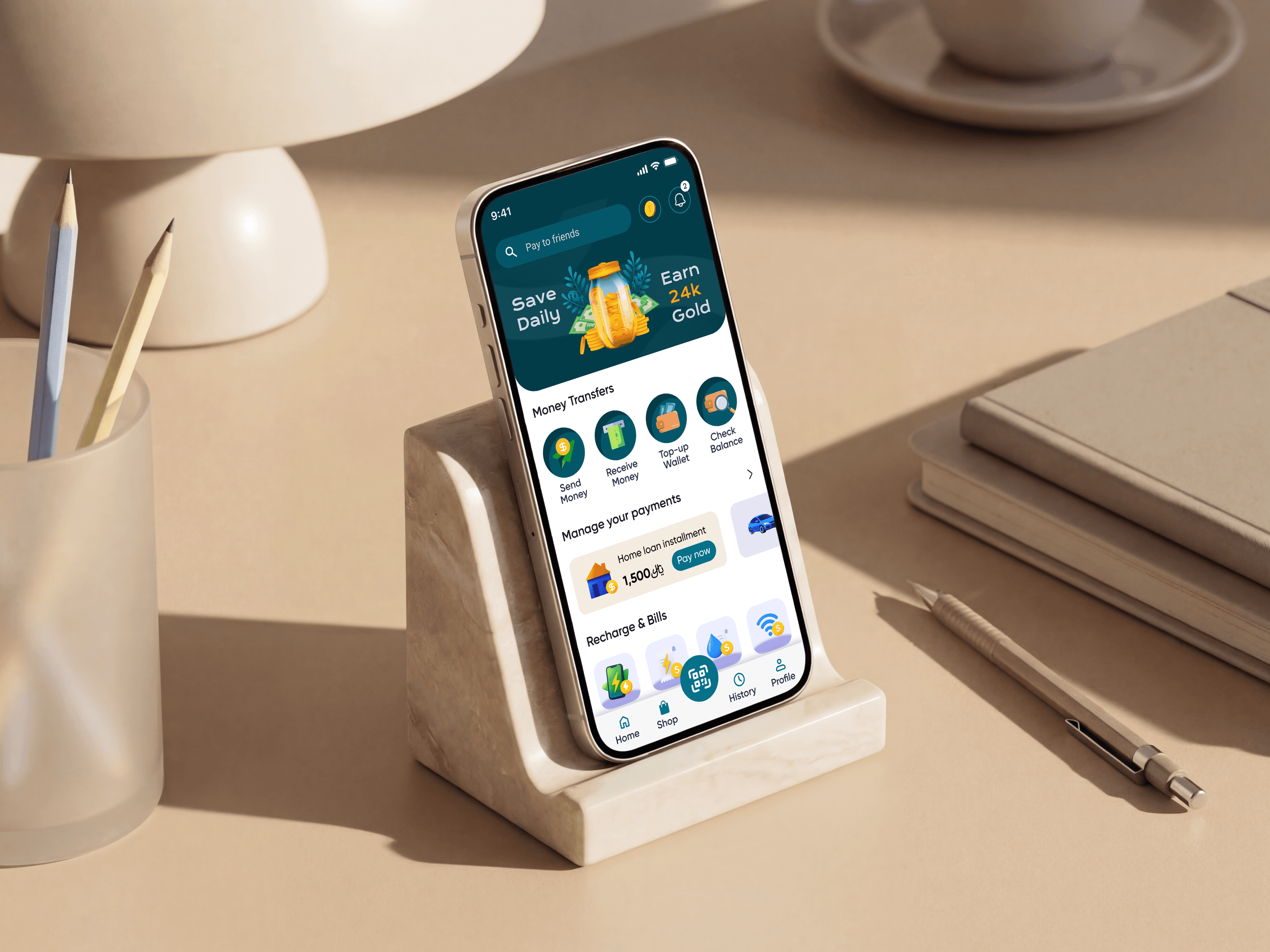
The redesign repositioned BayanPay as a unified super-wallet — a single app where users load money once and spend it everywhere: P2P transfers, grocery shopping at nearby marts, bill payments, rewards, and eventually investments and insurance. The app competes directly in a space where wallet adoption is low but smartphone penetration is among the highest in the region.
BayanPay is a Saudi Arabia-based fintech product targeting everyday users who are underserved by the current payment infrastructure. Despite a growing digital economy, most Saudi consumers still rely on credit and debit cards for everyday transactions, incurring unnecessary interchange fees, processing delays, and a fragmented experience across multiple apps for groceries, bills, and transfers.
The redesign repositioned BayanPay as a unified super-wallet — a single app where users load money once and spend it everywhere: P2P transfers, grocery shopping at nearby marts, bill payments, rewards, and eventually investments and insurance. The app competes directly in a space where wallet adoption is low but smartphone penetration is among the highest in the region.
The Problem
The Problem
Saudi Arabia lacks a unified UPI-style instant transfer rails system accessible to everyday consumers. The dominant behaviour remains card-based, which creates three real pain points:
Saudi Arabia lacks a unified UPI-style instant transfer rails system accessible to everyday consumers. The dominant behaviour remains card-based, which creates three real pain points:
1
Hidden transaction costs.
Every card-based payment whether in-store or online carries interchange fees ranging from 1.5% to 3.5%. For a user making 20–30 transactions a month, this is a silent, invisible tax they never agreed to.
1
Hidden transaction costs.
Every card-based payment whether in-store or online carries interchange fees ranging from 1.5% to 3.5%. For a user making 20–30 transactions a month, this is a silent, invisible tax they never agreed to.
2
Fragmentation fatigue.
Users juggle 4–6 apps to manage daily life: one for grocery delivery, one for ride-hailing, one for bill payment, one for remittances. Each app stores a separate card detail, creating security exposure and cognitive overload.
2
Fragmentation fatigue.
Users juggle 4–6 apps to manage daily life: one for grocery delivery, one for ride-hailing, one for bill payment, one for remittances. Each app stores a separate card detail, creating security exposure and cognitive overload.
2
No frictionless P2P layer.
Sending money to a friend requires either a bank transfer (slow, requires IBAN) or a third-party app. There is no "tap and send" experience tied to a local phone number.
2
No frictionless P2P layer.
Sending money to a friend requires either a bank transfer (slow, requires IBAN) or a third-party app. There is no "tap and send" experience tied to a local phone number.
Challenges
Challenges
1
The cold wallet problem. A wallet with zero balance is psychologically worthless. Users needed an immediate reason to top up within the onboarding flow itself.
1
The cold wallet problem. A wallet with zero balance is psychologically worthless. Users needed an immediate reason to top up within the onboarding flow itself.
2
Trust at first glance. Saudi fintech users are cautious. The original app felt generic and lacked the credibility signals needed to get someone to load real money into it.
2
Trust at first glance. Saudi fintech users are cautious. The original app felt generic and lacked the credibility signals needed to get someone to load real money into it.
3
Balancing simplicity vs. feature depth. BayanPay has 12+ features: wallets, P2P, grocery, bills, rides, investments, insurance, loans, rewards, budgeting, BNPL, and remittance. Showing all of them on the home screen would create a feature graveyard. Hiding them would kill discoverability.
3
Balancing simplicity vs. feature depth. BayanPay has 12+ features: wallets, P2P, grocery, bills, rides, investments, insurance, loans, rewards, budgeting, BNPL, and remittance. Showing all of them on the home screen would create a feature graveyard. Hiding them would kill discoverability.
4
Making the shopping experience feel native. Grocery and lifestyle shopping inside a wallet app risks feeling like an afterthought — a low-quality embedded browser rather than a first-class product.
4
Making the shopping experience feel native. Grocery and lifestyle shopping inside a wallet app risks feeling like an afterthought — a low-quality embedded browser rather than a first-class product.
5
Retention beyond the first week. Fintech apps see steep drop-off between D1 and D30. Most users open the app, make one transaction, and forget it exists
5
Retention beyond the first week. Fintech apps see steep drop-off between D1 and D30. Most users open the app, make one transaction, and forget it exists
Goals
Goals
1
Business goals:
1.Drive wallet top-up as the primary activation event within the first session 2.Build a daily active usage loop through grocery shopping and P2P transfers 3.Create lock-in through AutoPay, rewards tiers, and habit-forming budget tools 4.Expand monetisation through investment products and BNPL (Buy Now Pay Later) without overwhelming the core wallet experience
1
Business goals:
1.Drive wallet top-up as the primary activation event within the first session 2.Build a daily active usage loop through grocery shopping and P2P transfers 3.Create lock-in through AutoPay, rewards tiers, and habit-forming budget tools 4.Expand monetisation through investment products and BNPL (Buy Now Pay Later) without overwhelming the core wallet experience
2
User goals:
1.Send money to friends instantly using a phone number — no IBAN needed 2.Pay zero extra fees on everyday purchases by keeping money in the wallet 3.Shop for groceries and lifestyle products from nearby stores without switching apps 4.Understand where their money goes and feel in control of their finances
2
User goals:
1.Send money to friends instantly using a phone number — no IBAN needed 2.Pay zero extra fees on everyday purchases by keeping money in the wallet 3.Shop for groceries and lifestyle products from nearby stores without switching apps 4.Understand where their money goes and feel in control of their finances
3
Design goals:
1.Reduce time-to-first-transaction to under 2 minutes from app open. 2.Make the wallet balance the single most prominent element in the hierarchy. 3.Design a system that scales from "just send money" to "full financial life" without feeling bloated.
3
Design goals:
1.Reduce time-to-first-transaction to under 2 minutes from app open. 2.Make the wallet balance the single most prominent element in the hierarchy. 3.Design a system that scales from "just send money" to "full financial life" without feeling bloated.
Reflection
Reflection
The biggest lesson from this project was that wallet adoption is an emotional problem before it's a UX problem. Users don't switch from cards to wallets because the UI is cleaner they switch because the wallet makes them feel smarter about money. Every design decision was filtered through that lens: does this make the user feel like they're winning?
The rewards and cashback system wasn't a feature — it was the reframe. Paying from your wallet stops feeling like a compromise and starts feeling like an advantage. That shift in perception was the real design challenge, and the screens were just the vehicle to deliver it.
Tools
Tools
Figma
Google Dataproc
More projects